When were eyelash extensions invented? The modern semi-permanent eyelash extensions we know today emerged in the early 2000s from South Korea, but the concept of enhancing lashes dates back much further. Anna Taylor filed the first patent for artificial eyelashes in 1911, while ancient civilizations used kohl and natural materials to darken their lashes thousands of years earlier. The journey from these early experiments to the individual lash-by-lash application technique used at studios like Labelle Eyes in Westmount and Laval spans over a century of innovation.
This article traces the complete timeline of eyelash enhancement, from ancient practices through Hollywood’s false lash era, to the semi-permanent extension revolution that transformed beauty salons across Montreal and Quebec.
Quick Answer
Modern semi-permanent eyelash extensions were invented in South Korea in the early 2000s, building on Anna Taylor’s 1911 patent for artificial eyelashes. The technique reached North American salons by 2004 and arrived in Montreal’s professional beauty market between 2006 and 2008.
Ancient Origins: Early Eyelash Enhancement Before Modern Inventions
Long before anyone filed a patent for artificial lashes, ancient civilizations understood the power of emphasized eyes. Egyptian men and women applied kohl, a mixture of galena and soot, along their lash lines as early as 3000 BCE. This dark pigment reduced sun glare and offered some protection against eye infections.
Roman writers documented their own lash enhancement practices. Pliny the Elder noted in the first century CE that women used burnt cork and elder berry juice to darken their lashes, creating the illusion of thickness and length. These ancient techniques focused on enhancing natural lashes rather than adding artificial ones, but the cultural obsession with dramatic eyes was firmly established across multiple continents.
Key Takeaways
- Understand that semi-permanent extensions emerged in Korea around 2003-2004
- Recognize Anna Taylor’s 1911 patent as the first documented artificial lash
- Know that strip lashes differ fundamentally from individual lash extensions
- Expect modern techniques to use medical-grade cyanoacrylate adhesives
- Choose certified technicians trained in post-2000s application methods
The 1880s-1910s: When False Eyelashes Were First Invented
The late 19th century saw the first documented attempts to create artificial eyelashes. In 1882, London-based hair merchant Henry Labouchere reported on a Parisian technique where human hair was sewn through the eyelid skin. This brutal procedure caused infections and was quickly abandoned, though it proved there was demand for lash enhancement solutions.
Debunking the Gerda Puridle Myth
You may have encountered the story that prostitutes in 1880s Paris invented false eyelashes, centering on a woman named Gerda Puridle. This story is completely false. No historical records, patent filings, or period newspapers mention anyone by this name. The myth appears to have originated from fabricated internet content in the early 2000s. Real innovations deserve credit, and the actual inventors, primarily women working in early 20th century beauty and film, should not be erased by sensationalized fiction.
Anna Taylor’s 1911 Patent: The First Documented Artificial Eyelash Design
Canadian inventor Anna Taylor filed the first verifiable patent for artificial eyelashes on June 6, 1911. Her design used a crescent-shaped fabric strip with small hairs attached, positioned along the eyelid edge using adhesive. Taylor’s invention laid the groundwork for temporary strip lashes, but the fabric strip was visible and uncomfortable, and the adhesive irritated many wearers’ skin.
Expert Tip from Labelle Eyes
Early adhesives caused allergic reactions in many wearers. Today’s medical-grade cyanoacrylate bonds used in our Westmount and Laval studios undergo strict safety testing and create flexible bonds that move naturally with your lashes.
Hollywood’s Golden Age: How Film Stars Popularized Eyelash Enhancements
The 1920s and 1930s transformed false eyelashes from theatrical novelty to mainstream beauty product. Hollywood makeup artists needed to create dramatic looks that would register on early black-and-white film stock. Max Factor began mass-producing false eyelash strips in 1930, using finer materials and better adhesives than earlier designs.
Actresses like Jean Harlow, Marlene Dietrich, and Joan Crawford wore dramatic false lashes both on screen and in public appearances, creating demand among everyday women. The 1960s brought another surge when British model Twiggy made exaggerated lower lashes her signature look. Cosmetics companies responded with individual lash clusters that could be applied to specific areas. These clusters represented a step toward modern extension techniques, though they still attached to the skin rather than individual natural lashes.
LABELLE EYES
Ready for perfect lashes?
Book your consultation today at our Westmount or Laval studio and let our certified lash technicians create your perfect look.
The Modern Eyelash Extension Revolution: Semi-Permanent Techniques Emerge
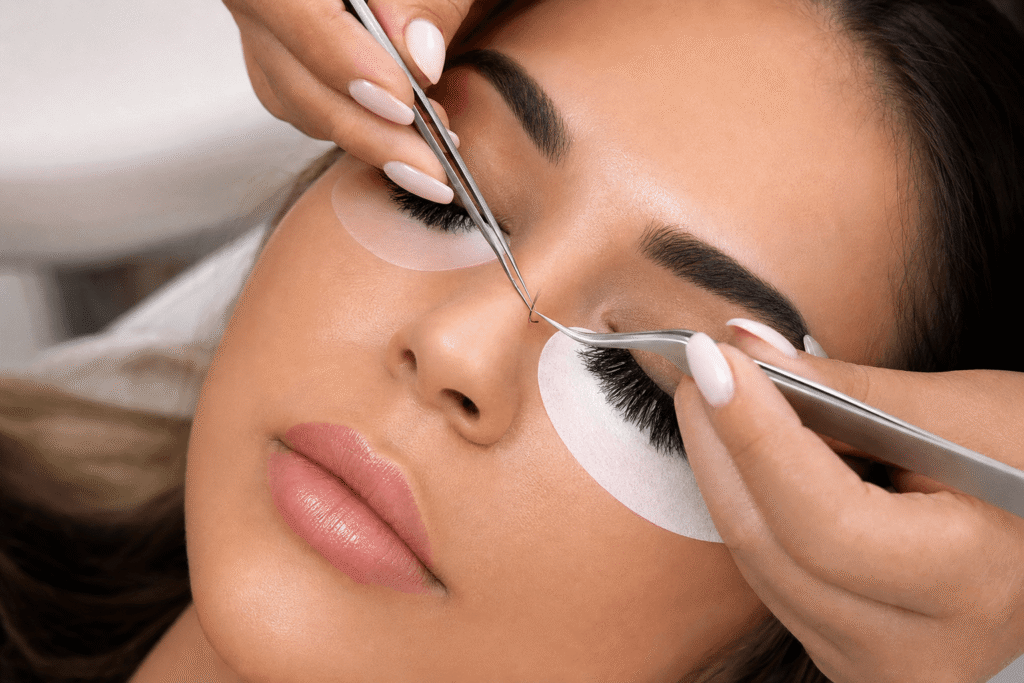
Everything changed in the early 2000s. The semi-permanent eyelash extension technique, where individual synthetic lashes are bonded to individual natural lashes, emerged as a distinct innovation. South Korean beauty technicians developed the modern application method around 2003-2004. Instead of attaching lashes to skin, they bonded individual synthetic fibers to each natural lash using specialized cyanoacrylate adhesives. This technique required extensive training and created results that looked and moved like natural lashes because they grew out with them.
Korean vs American Innovation Paths
Korean and Japanese salons initially drove innovation in lash extension techniques. They developed systematic training programs, created specialized isolation techniques, and refined adhesive formulations. Korean manufacturers also pioneered varying curl types and diameter options, giving technicians more tools to customize results.
American adoption followed a different path. When the technique reached the United States around 2004-2005, American technicians adapted Korean methods and developed distinct application styles. The American lash industry emphasized dramatic volume and length, leading to innovations in fan-making techniques that eventually became volume lash extensions.
How Eyelash Extensions Arrived in Canada and Quebec’s Beauty Market
The semi-permanent eyelash extension technique reached Canadian salons between 2006 and 2008. Montreal’s beauty industry embraced the technique quickly once trained technicians became available. Quebec’s beauty regulatory environment required technicians to hold esthetician certification before specializing in lash extensions. This created a higher barrier to entry than in some provinces, but it also meant that Quebec lash technicians brought strong foundational knowledge of skin health, sanitation, and client safety to the new technique.
Timeline of Eyelash Extension Adoption in Montreal and Quebec
2006: First Montreal salons begin offering eyelash extensions after technicians travel to South Korea and the United States for training. Downtown studios on Saint-Catherine Street become early adopters, though services remain expensive and appointments scarce.
2007-2008: Second wave of salons adds lash extensions to service menus as awareness grows among Montreal clients. Professional supply distributors begin importing Korean-manufactured synthetic lashes and adhesives, reducing technician costs.
2009-2011: First Montreal-based training programs launch, eliminating the need for international travel. Quebec estheticians can now add lash extension certification without leaving the province. Supply chains improve as Canadian distributors stock professional materials.
2012-2014: Specialized lash studios open, focusing exclusively on extension services rather than offering them alongside other treatments. Labelle Eyes launched in 2014 as part of this specialization wave, bringing dedicated lash expertise to Montreal.
2015-2018: Suburban expansion occurs as demand spreads beyond downtown. Studios open in Westmount, Laval, and surrounding neighborhoods. Quebec clients develop distinct preferences for natural looks compared to the dramatic volume popular in other North American cities.
2019-present: The Quebec lash market matures with established studios, consistent training standards, and widespread client education about proper aftercare and realistic expectations.
The Evolution of Materials and Adhesive Technology
The transformation from early false lashes to modern extensions required revolutionary advances in both lash materials and bonding agents. Understanding this evolution reveals why contemporary extensions outperform earlier products in safety, durability, and appearance.
Lash Material Evolution
Early false lashes used human hair attached to fabric or metal bands. These materials created unnatural textures and limited styling options. Today’s lash extensions are made primarily from PBT (polybutylene terephthalate), a synthetic polymer fiber. PBT maintains its curl permanently without heat styling, is waterproof and lightweight, and is hypoallergenic. Unlike real hair, PBT does not absorb moisture or oils, so extensions maintain their appearance throughout their wear period.
Technical Evolution of Adhesive Formulations
Anna Taylor’s 1911 patent used unspecified adhesive, likely a variant of spirit gum used in theatrical applications. These early adhesives were designed for temporary attachment to skin and broke down quickly when exposed to moisture, oils, or facial movement. Mid-century strip lashes used latex-based glues that caused frequent allergic reactions and lost adhesion within hours.
The breakthrough came with cyanoacrylate-based adhesives in the early 2000s. Modern lash extension adhesives use medical-grade cyanoacrylate, the same chemical family as surgical adhesives used to close wounds. These formulations create flexible bonds that withstand water, oil, and normal facial movement. The adhesive cures through moisture in the air, creating a strong bond within seconds that lasts 4-6 weeks.
| Adhesive Era | Primary Ingredient | Bond Duration | Key Limitation |
|---|---|---|---|
| 1910s-1960s | Spirit gum / latex | 4-8 hours | Skin irritation, visible residue |
| 1970s-1990s | Rubber-based glue | 12-24 hours | Allergic reactions, poor water resistance |
| 2000s-present | Cyanoacrylate | 4-6 weeks | Requires proper isolation technique |
At Labelle Eyes, adhesive selection varies based on client sensitivity and desired retention, with low-fume options available for clients with watery eyes or mild sensitivities.
Economic Impact and Industry Growth Statistics
The eyelash extension industry has grown from essentially zero revenue in 2000 to a global market valued at approximately $1.6 billion USD in 2023. North America represents the largest regional market, followed by Asia-Pacific and Europe. Industry analysts project the market will reach $2.1 billion by 2028, representing a compound annual growth rate of 5.6%.
Professional lash studios, rather than general salons offering extensions as one service, drove much of this growth. In the United States alone, the number of dedicated lash studios grew from fewer than 500 in 2010 to over 15,000 by 2023.
Employment in the lash extension sector has expanded dramatically. An estimated 50,000 lash technicians work in North America as of 2023, compared to fewer than 5,000 in 2008. Quebec’s requirement that lash technicians hold esthetician certification means the province has higher training standards than many jurisdictions, contributing to the quality reputation of Montreal lash studios.
Quebec and Montreal Market Growth
The Quebec beauty services market grew from $2.8 billion CAD in 2010 to $4.1 billion CAD in 2023, with lash extension services representing one of the fastest-growing segments. Montreal’s specialized lash studios numbered approximately 15 in 2012 and exceeded 120 by 2023, reflecting the rapid adoption of semi-permanent extensions among Quebec clients.
The average Montreal lash technician completes 15-25 full sets monthly, generating between $45,000 and $75,000 CAD in annual revenue per technician. Studios employing multiple certified technicians contribute substantially to local employment, with the greater Montreal area supporting an estimated 300-400 specialized lash professionals as of 2023.
The COVID-19 pandemic created temporary disruption in 2020-2021, with Quebec beauty services declining approximately 40% during lockdown periods. The industry rebounded quickly as studios implemented enhanced safety protocols, with 2022 revenue in Montreal surpassing 2019 levels as clients returned to regular lash appointments.
Why Understanding Lash Extension History Matters When Choosing Your Studio
Knowing this history helps you evaluate studios and technicians. A studio that understands the evolution from strip lashes to semi-permanent extensions, that can explain why modern cyanoacrylate adhesives outperform earlier formulations, and that recognizes the difference between Korean and American technique development demonstrates real expertise.
When you book a consultation, ask about training background. Technicians should explain where they trained, what techniques they specialize in, and how they stay current with innovations. At Labelle Eyes, every consultation includes education about the technique you are receiving. Whether you are booking classic extensions, volume sets, or trying extensions for the first time, our team explains what makes modern applications different from strip lashes and why proper technique creates results that enhance rather than damage your natural lashes.
Frequently Asked Questions
When were eyelash extensions invented?
Modern semi-permanent eyelash extensions were invented in South Korea around 2003-2004. This technique bonds individual synthetic lashes to individual natural lashes using medical-grade adhesive. The semi-permanent extension technique reached North America by 2004-2005 and Montreal between 2006-2008.
Who actually invented eyelash extensions?
South Korean beauty technicians developed the modern semi-permanent eyelash extension application method in the early 2000s, though no single inventor is credited. They pioneered the isolation technique, specialized cyanoacrylate adhesives, and individual application method used today.
Did a prostitute named Gerda Puridle invent fake eyelashes?
No, this is completely false. No historical records, patents, or period documents mention anyone named Gerda Puridle. This myth originated from fabricated internet content in the early 2000s. The actual documented inventor of the first patented artificial eyelashes was Anna Taylor in 1911.
What’s the difference between false eyelashes and eyelash extensions?
False eyelashes (strip lashes) are temporary accessories that attach to your eyelid skin using temporary adhesive. You apply them daily and remove them each night. Semi-permanent eyelash extensions attach individual synthetic lashes to individual natural lashes using medical-grade cyanoacrylate adhesive and last 4-6 weeks.
When did eyelash extensions become popular in Montreal and Quebec?
Eyelash extensions reached Montreal salons between 2006-2008. Dedicated lash studios began opening around 2010, with specialized studios like Labelle Eyes launching in 2014. Quebec’s requirement that lash technicians hold esthetician certification before specializing created higher standards than many other jurisdictions.
The journey from Anna Taylor’s 1911 patent to the semi-permanent extensions available at studios throughout Montreal represents over a century of innovation. Modern lash extensions combine Korean precision techniques, advanced synthetic materials, and medical-grade adhesives to create results that early inventors could never have imagined. Since arriving in Quebec between 2006-2008, the industry has matured with established training standards and widespread client education. Understanding this evolution helps you appreciate the expertise required for proper application and recognize the difference between qualified professionals and inexperienced technicians.
Ready to experience the modern evolution of eyelash extensions? Book your appointment at our Westmount location at 4055 Saint-Catherine St W, Unit 115, or our Laval studio at 3742 Boulevard Levesque O. Call (438) 408-6826 to speak with our certified lash technicians about which extension style suits your natural lash pattern and lifestyle. Your consultation includes a custom lash mapping session where we will design your perfect look using techniques refined over decades of industry innovation.