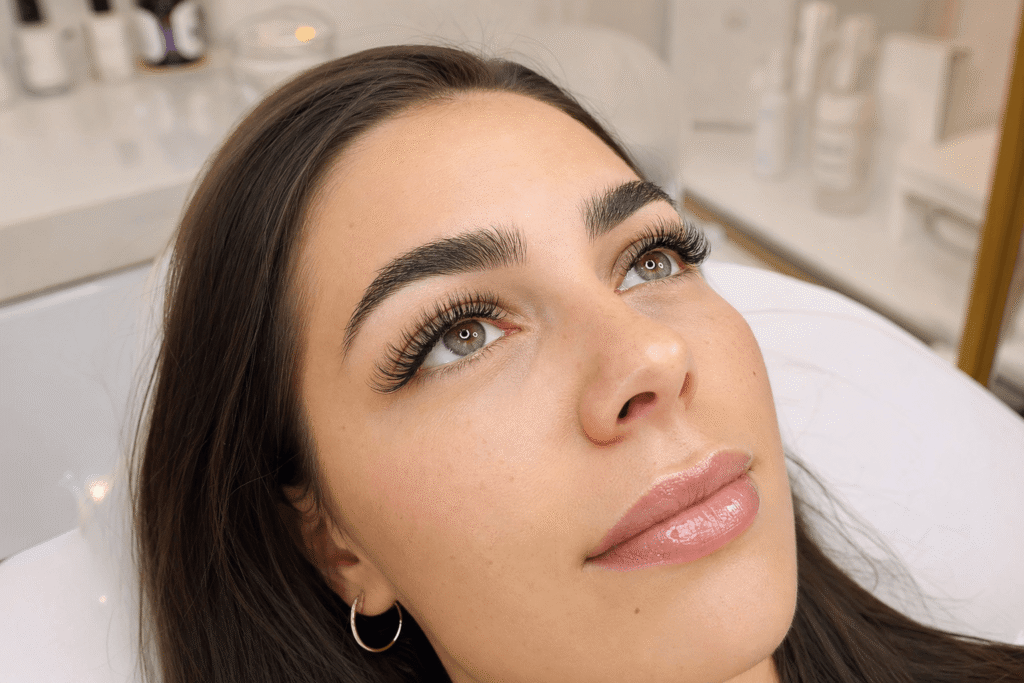
If you’re considering eyelash extensions or already have them, understanding how long they actually last is essential for planning your maintenance schedule and budget. Eyelash extensions typically last 4-6 weeks with proper care, but individual lash retention varies based on your natural lash growth cycle, aftercare habits, and the type of extensions you choose.
This article covers everything you need to know about eyelash extension longevity: the science behind retention, a week-by-week timeline of what to expect, factors that affect how long your lashes stay put, essential aftercare practices, and when to schedule fill appointments. You’ll also learn how different extension styles (classic, hybrid, volume) impact retention rates and what realistic expectations look like at each stage.
Quick Answer
Eyelash extensions last 4-6 weeks on average, following your natural lash growth cycle. Most clients need fill appointments every 2-3 weeks to maintain a full look, as 20-40% of extensions naturally shed with your lashes during that time.
How Long Do Eyelash Extensions Last? The Complete Answer
The straightforward answer is that individual eyelash extensions stay attached for the entire lifespan of your natural lash, which ranges from 6-8 weeks depending on where that lash is in its growth cycle. But since your natural lashes are constantly at different stages, you’ll notice gradual shedding from day one.
Most clients see noticeable thinning around the 2-3 week mark. This is completely normal and expected. Your extensions aren’t falling out prematurely; they’re simply following your natural lash cycle.
At Labelle Eyes, Benny and the team explain to every client during their initial consultation that you’ll lose 1-5 natural lashes per day naturally, whether you have extensions or not. When extensions are attached, they fall out with those natural lashes. This means you can expect to lose roughly 15-35 extension lashes over a two-week period.
The visible impact depends on your total lash count. If you started with 80-100 extensions per eye (typical for a classic set), losing 20-30 over two weeks still leaves you with 60-70 per eye. That’s when most clients book their first fill. Some wait longer if they prefer a lighter look, while others prefer fills every 2 weeks to maintain maximum fullness.
Key Takeaways
- Expect individual extensions to last the full 6-8 week natural lash cycle
- Book fill appointments every 2-3 weeks to maintain fullness and appearance
- Choose volume or hybrid styles for less noticeable shedding between fills
- Follow proper aftercare to maximize retention and avoid premature loss
- Understand your natural shedding rate before assuming extensions are falling out early
Understanding Your Natural Eyelash Growth Cycle
Your natural lashes grow in three distinct phases, and understanding this cycle explains why extensions don’t all fall out at once. Each individual lash follows its own timeline, which is why you have a full lash line at all times despite constant shedding.
The anagen phase is the active growth period lasting 30-45 days. Extensions applied during this phase have the longest retention because these lashes are firmly rooted and won’t shed for several more weeks. The catagen phase is a short transitional period lasting 2-3 weeks where growth stops. The telogen phase is the resting period lasting around 100 days before the lash eventually sheds.
At any given time, roughly 40% of your upper lashes are in anagen, 5-10% are in catagen, and 50-55% are in telogen. A skilled lash technician can sometimes identify telogen lashes, but it’s impossible to know exactly when each lash will shed.
This is why two clients can receive identical applications with the same aftercare and have different retention rates. One client might have more lashes in early anagen at application time, resulting in better retention. The other might have more late-stage telogen lashes that shed within the first week.
Expert Tip from Labelle Eyes
At our Westmount and Laval studios, we avoid applying extensions to extremely short or weak natural lashes, as these are typically early anagen or late telogen lashes with poor retention potential.
Week-by-Week Timeline: What to Expect From Your Extensions
Understanding the realistic timeline helps set proper expectations and prevents panic when you notice natural shedding. Here’s what most clients experience from application through week six.
| Week | Extensions Remaining | Appearance | Action Needed |
|---|---|---|---|
| Week 1 | 90-95% | Fullest look, minimal gaps | None |
| Week 2 | 80-85% | Small gaps appearing | Optional fill for perfectionists |
| Week 3 | 65-75% | Noticeable thinning | Fill recommended |
| Week 4 | 50-60% | Significant density loss | Fill needed |
| Weeks 5-6 | 30-40% | Sparse, scattered lashes | New full set recommended |
Week 1: Your extensions look their absolute fullest. You’ll notice maybe 3-7 lashes falling out throughout the week, which is normal natural shedding. This is the honeymoon period where extensions require minimal styling and look perfect when you wake up.
Week 2: You’ll start noticing small gaps, particularly in areas where you naturally have fewer lashes. Expect to lose another 7-12 extensions during this week. Your lash line still looks full in photos and from conversation distance.
Week 3: Thinning becomes more noticeable, especially on the outer corners. You’ve now lost roughly 20-35% of your original set. The gaps are obvious in close-up mirrors. This is when most clients book their first fill appointment to restore fullness.
Week 4: You’re approaching the 50% mark in terms of lash loss. Your extensions still create a noticeable enhancement over bare lashes, but the symmetry and density have significantly decreased.
Weeks 5-6: At this point, you’re down to 30-40% of your original extensions. The lashes that remain are scattered randomly with large bare areas between them. Most technicians recommend a fresh full set rather than a fill if you wait this long.
Benny often explains to clients at the Westmount studio that waiting beyond 3-4 weeks typically costs more in the long run. A fill appointment adds 30-50 extensions and takes 45-60 minutes. Waiting until week 5-6 means you need 60-80+ new extensions, which takes 90+ minutes and may cost nearly as much as a new full set.
Key Factors That Affect Eyelash Extension Retention
Retention isn’t just about natural lash cycles. Several external and internal factors influence how well extensions bond and how long they stay attached. Understanding these helps you maximize longevity and troubleshoot poor retention.
Environmental Factors
Lash adhesive is remarkably sensitive to environmental conditions, particularly in the first 24-48 hours after application. Most professional adhesives cure optimally at 45-60% humidity and 68-72°F. At Labelle Eyes’ Laval and Westmount locations, the application rooms maintain controlled humidity levels year-round to ensure consistent adhesive performance regardless of outside weather. Excessive heat exposure in the first 48 hours (saunas, hot yoga, steam rooms) can compromise the bond before it’s fully cured.
Health and Lifestyle Factors
Your body chemistry directly affects retention in ways most clients don’t realize. Oily skin types naturally produce more sebum, which travels along the lash shaft and weakens the adhesive bond. If you have oily eyelids, expect slightly shorter retention and be extra diligent about daily cleansing.
Hormonal changes significantly impact both lash growth cycles and oil production. Menstruation can speed up your natural lash cycle, causing more shedding during your period. Pregnancy often accelerates lash growth and shedding due to elevated estrogen levels, meaning you may need fills more frequently. Menopause typically slows lash growth and can make lashes thinner and more brittle, affecting how well extensions adhere. Thyroid disorders (hypothyroidism or hyperthyroidism) disrupt normal lash cycles, either slowing growth dramatically or causing excessive shedding.
Medications affect retention more than most people realize. Hormone replacement therapy and birth control pills alter your natural hormone balance and oil production. Thyroid medications (levothyroxine, methimazole) can change lash growth patterns during dosage adjustments. Some antidepressants and chemotherapy drugs cause lash thinning or altered growth cycles. If you start new medications and notice sudden retention changes, discuss this with your lash technician.
Sleep position matters more than most people think. Sleeping face-down or rubbing your face into your pillow creates mechanical friction that loosens extensions. Side sleepers often notice faster shedding on whichever side they favor. Using a silk pillowcase reduces friction significantly compared to cotton.
LABELLE EYES
Ready for perfect lashes?
Book your consultation today at our Westmount or Laval studio and let our certified lash technicians create your perfect look.
Essential Aftercare: How to Make Your Eyelash Extensions Last Longer
Proper aftercare is the single biggest controllable factor in extension longevity. Even perfect application will fail if you don’t maintain your extensions correctly. The good news is that proper care takes just minutes per day once you establish the routine.
The 24-hour rule is critical. Keep extensions completely dry for the first 24 hours after application. No showers hitting your face, no swimming, no crying, no steam. The adhesive needs this time to fully cure without interference. Breaking this rule is the most common cause of premature shedding in the first week.
After that initial period, daily cleansing becomes your most important habit. This seems counterintuitive since you’re trying to keep extensions on, but clean lashes last longer than dirty ones. Oil, makeup residue, dead skin, and natural debris accumulate at the lash line and break down adhesive bonds.
How to Properly Cleanse Your Eyelash Extensions
Use an oil-free lash cleanser specifically formulated for extensions. Apply cleanser with a soft cleansing brush or clean fingertips, using gentle downward strokes along the lash line. Focus your cleaning on the lash base where oil and debris accumulate, not the extension length. Rinse thoroughly with lukewarm water, ensuring all cleanser is removed. Pat dry gently with a lint-free towel, then brush through with a clean spoolie brush once completely dry.
Clean your extensions every single day if you wear eye makeup, have oily skin, or live in a humid climate. Every other day is acceptable if you wear no eye makeup and have normal to dry skin. Never go more than two days without cleansing.
Products and Habits to Avoid
All oil-based products are enemies of lash adhesive. This includes makeup removers, cleansers, moisturizers, and eye creams. Even if you’re careful to avoid the lash line, oils migrate. Switch to oil-free alternatives for your entire eye area.
Waterproof mascara requires oil-based remover to break down, so it’s incompatible with extensions. Regular mascara on extensions is possible but generally unnecessary. If you must use mascara, apply it only to the tips of extensions, never the base, and use only water-based formulas.
Mechanical lash curlers will break extensions and should never be used. Your extensions are already curled, and attempting to curl them further damages both the extension and your natural lash. Rubbing or pulling at your lashes causes premature shedding and can damage your natural lashes.
You can find detailed guidance on proper extension aftercare practices and step-by-step cleaning techniques to ensure your lashes last as long as possible.
When to Book Your Fill Appointment (And What Happens If You Wait)
The optimal fill timing is 2-3 weeks after your full set, when you’ve lost roughly 30-40% of your extensions but still have a solid base to build upon. This timing maintains consistent fullness without requiring excessive time or cost at each appointment.
Book too early (within the first 10 days), and you’re spending money unnecessarily since your lashes still look full. Book too late (beyond 4 weeks), and you’ve lost so many extensions that the appointment takes much longer and may cost nearly as much as a new full set.
The difference between a fill and a new set isn’t arbitrary. A fill appointment involves removing any loose or twisted extensions, then adding new extensions to natural lashes that have come in since your last appointment or lost their extensions. This typically means adding 30-60 new extensions per eye and takes 45-75 minutes.
A new full set involves applying extensions to 80-120+ natural lashes per eye and takes 90-120 minutes or more. Most technicians define the cutoff at 50% retention. If you have more than half your extensions remaining, it’s a fill. Below 50%, you’re better off starting fresh.
What Waiting Too Long Actually Looks Like
At week 3, you’ll notice obvious gaps but the overall lash line still appears enhanced. Extensions are clustered in groups of 3-5 lashes with visible spaces between clusters. The outer corners typically show the most loss, with the center lash line maintaining better density. A fill at this stage adds 40-50 lashes per eye and takes about 60 minutes.
At week 4-5, your lashes look sparse and uneven with obvious asymmetry between eyes. You might have 15-20 extensions scattered across each eye in isolated singles or pairs. Large bare patches interrupt the lash line, particularly at the inner and outer corners. The remaining extensions often appear at inconsistent angles since the surrounding lashes that provided structure have shed. A technician needs to add 70-90 lashes per eye, taking 90+ minutes. At this point, the time and cost approach that of a new full set.
At week 6+, you have isolated extensions with large bare patches dominating the lash line. The asymmetry is obvious, with one eye often retaining significantly more extensions than the other. Most technicians will recommend removing the remaining extensions and starting fresh rather than trying to fill around scattered lashes.
Waiting too long creates another issue beyond cost: asymmetry. If you lost 70% of extensions on your left eye but only 60% on your right, the technician needs to balance fullness while working with what remains. Sometimes this means removing healthy extensions from the fuller side to create symmetry.
Different extension types have different ideal fill schedules. Classic lash fills are typically needed every 2-3 weeks. Hybrid extension fills can sometimes stretch to 3 weeks because the volume fans maintain more visual density. Volume lash fills often look acceptable for 3-4 weeks due to the higher density.
At Labelle Eyes’ Westmount and Laval locations, the team helps clients establish a maintenance schedule during their first appointment based on their natural shedding rate, lifestyle, and fullness preferences. Some clients love the dramatic look and book standing appointments every 2 weeks. Others prefer a lighter enhancement and come in every 3-4 weeks.
Expert Tip from Labelle Eyes
If you’re traveling or have a special event, book your fill 3-5 days before rather than the day of. This allows any initial shedding to occur and ensures you look your absolute best.
How Extension Type Impacts Longevity: Classic vs Hybrid vs Volume
The technique and style you choose affects both actual retention and perceived longevity. Understanding the differences helps you select the right type for your maintenance preferences and lifestyle.
Classic Extensions: Natural Enhancement
Classic extensions involve applying one extension to one natural lash. This creates a natural enhancement that’s noticeable but not dramatic. Retention is straightforward: when a natural lash sheds, you lose one extension, creating one visible gap. Classic sets show thinning more obviously because each missing extension is individually noticeable.
The one-to-one application means shedding creates visible spaces that draw attention. When you lose 20 extensions from a classic set of 80 per eye, those 20 gaps are immediately apparent. Classic works beautifully if you have naturally dense lashes and want subtle enhancement. The one-to-one ratio means less weight on each natural lash, which can be beneficial if your natural lashes are fine or sparse. Expect to need fills every 2-3 weeks to maintain a consistently full look. Retention rate averages 65-75% at week 3.
Hybrid Extensions: Best of Both Worlds
Hybrid extensions combine classic and volume techniques, typically in a 50/50 or 70/30 ratio. You get some single extensions and some volume fans, creating more density and texture than classic alone. Hybrid sets hide shedding better than classic because the volume fans maintain visual fullness even as some classic extensions fall out.
When a natural lash sheds, you might lose a 3-fan volume cluster, but the surrounding single classic lashes and other fans fill the visual space more effectively than classic alone. The mixed technique means you can stretch slightly longer between fills while still maintaining an acceptably full look. Many clients who try classic first switch to hybrid specifically because they prefer the 2.5-3 week fill schedule versus the 2-week schedule classic often requires. Retention rate averages 70-80% at week 3.
Volume Extensions: Maximum Drama and Retention
Volume extensions involve applying lightweight fans of 2-6 ultra-fine extensions to each natural lash. This creates dramatic density and a fuller lash line. Volume sets have the best perceived retention because when one natural lash sheds, you lose an entire fan, but the surrounding fans are dense enough that the gap is barely noticeable.
The high density means losing 30% of your extensions still leaves substantial fullness. Where classic sets look noticeably thin at 70% retention, volume sets still look acceptably full at 60-65% retention. The ultra-fine diameter of volume lashes (0.03-0.05mm versus 0.10-0.15mm for classic) means you can apply more extensions without overloading natural lashes. Despite having more total extensions, volume sets are often lighter than classic sets because the individual lashes weigh so little. Volume clients frequently wait 3-4 weeks between fills because their lashes still look acceptably full at that point. Retention rate averages 75-85% at week 3.
Mega volume pushes this concept further with fans of 6-16+ lashes per natural lash. This creates the most dramatic look and the longest perceived retention, though actual retention per individual lash is the same. The extreme density means even significant shedding is barely visible. Mega volume clients can sometimes stretch to 4 weeks if they’re comfortable with gradual thinning. Retention rate averages 80-90% at week 3.
| Extension Type | Typical Fill Schedule | Week 3 Retention Rate | Best For |
|---|---|---|---|
| Classic | 2-3 weeks | 65-75% | Natural look, fine lashes |
| Hybrid | 2.5-3 weeks | 70-80% | Enhanced density, first-timers |
| Volume | 3-4 weeks | 75-85% | Dramatic look, sparse lashes |
| Mega Volume | 3-4 weeks | 80-90% | Maximum drama, events |
Benny typically recommends that first-time clients at the Westmount studio start with hybrid extensions. This provides enough density to appreciate the impact of extensions while requiring less dramatic maintenance than volume. Clients can always move to volume or scale back to classic at their next fill based on their experience.
Frequently Asked Questions
How long do eyelash extensions typically last?
Individual extensions last 6-8 weeks following your natural lash cycle. However, you’ll notice gradual thinning as lashes shed naturally. Most clients need fills every 2-3 weeks to maintain fullness. Exact timing depends on your lash cycle, extension type, and aftercare.
How many eyelash extensions fall out per day normally?
You naturally shed 1-5 lashes per eye daily, with or without extensions. When extensions are attached, they fall with natural lashes. Losing 2-10 extension lashes daily is completely normal. Over two weeks, expect to lose 20-35 extensions total.
How often should I get eyelash extension fills?
The ideal schedule is every 2-3 weeks for classic, 2.5-3 weeks for hybrid, and 3-4 weeks for volume sets. This maintains fullness without excessive cost. Waiting beyond 4 weeks means you’ve lost 50%+ of extensions and need a new full set instead.
Can I get my eyelash extensions wet after application?
Keep extensions completely dry for 24 hours after application to allow adhesive to cure. No showers on your face, swimming, or steam. After 24 hours, getting them wet is fine. Daily cleansing with oil-free lash cleanser actually improves retention.
Will eyelash extensions damage my natural lashes?
Properly applied extensions by certified technicians don’t damage natural lashes. Damage occurs when extensions are too heavy, multiple lashes are glued together, or you pull them off yourself. Proper application with appropriate weight and professional removal prevents damage completely.
Understanding how long eyelash extensions actually last is essential for setting realistic expectations and planning your maintenance schedule. With proper application by certified technicians, consistent aftercare, and regular fill appointments every 2-3 weeks, you can maintain beautiful, full lashes continuously. The natural shedding you’ll notice is completely normal and reflects your body’s healthy lash growth cycle, not poor application or product quality.
Ready to experience long-lasting, beautiful eyelash extensions? Book your consultation at Labelle Eyes’ Westmount or Laval studio. Benny and the certified lash technician team will assess your natural lashes, discuss your maintenance preferences, and create a customized extension plan that fits your lifestyle. Call (438) 408-6826 or visit us at 4055 Saint-Catherine St W, Unit 115, Westmount, or 3742 Boulevard Levesque O, Laval to get started with lashes that last.