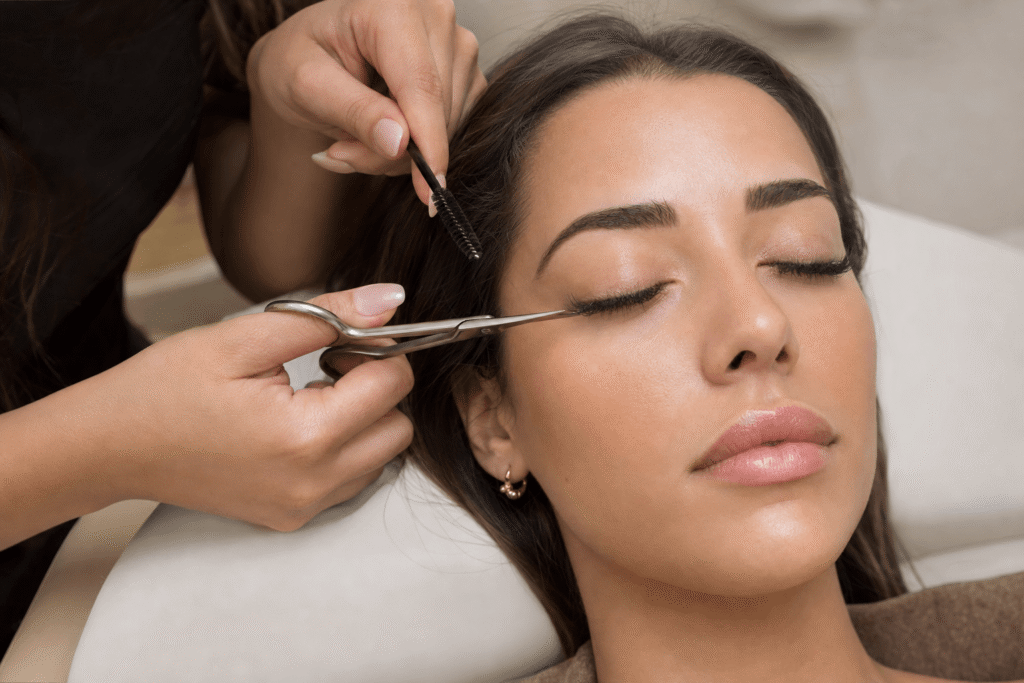
Wondering if you can trim eyelash extensions that feel too long or dramatic? This is one of the most common questions clients ask after their first lash appointment. The short answer is yes, you technically can trim extensions, but doing so comes with significant risks that most people don’t anticipate until it’s too late. This guide covers exactly what happens when you cut lash extensions, step-by-step instructions if you absolutely must trim them, and most importantly, the professional alternatives that preserve both your extensions and natural lashes.
Quick Answer
You can trim eyelash extensions, but it creates blunt, unnatural-looking tips and risks cutting your natural lashes. Professional removal or adjustment during a fill appointment is always safer and maintains the tapered shape extensions need to look natural.
Can You Trim Eyelash Extensions? The Direct Answer
Yes, you can physically trim lash extensions with scissors. But that doesn’t mean you should.
Individual lash extensions are manufactured with a carefully tapered tip that mimics how natural lashes grow. When you cut an extension, you remove this taper and create a blunt, flat edge. The result looks nothing like a real lash.
Think about the difference between a naturally pointed eyelash and one that’s been snipped straight across. The blunt edge catches light differently, feels different against your skin, and immediately signals that something is off about your lashes. Most clients who trim their extensions at home end up booking emergency removal appointments within 48 hours because the results look so obviously altered.
Key Takeaways
- Avoid trimming extensions as it removes the natural taper and creates blunt tips.
- Expect visible damage if you cut too close to natural lashes accidentally.
- Wait for natural shedding cycles to gradually reduce dramatic length over weeks.
- Book professional removal if extensions feel uncomfortable rather than trimming at home.
- Ask your lash technician about length during consultation to prevent trimming needs.
Why People Want to Trim Their Lash Extensions
Length issues drive most trimming attempts. Someone leaves their appointment thrilled with dramatic volume but realizes the next morning that 14mm extensions hit their glasses every time they blink. Or they chose a glamorous look for a special event and now need something more workplace-appropriate.
Lifestyle conflicts emerge quickly. Poor application technique also leads to trimming temptation. If a lash technician applies extensions without considering your eye shape, natural lash strength, or daily activities, you might end up with lengths that poke your brow bone, cross over each other, or sit at awkward angles. In these cases, trimming won’t solve the underlying application problem.
Expert Tip from Labelle Eyes
Give yourself three full days before deciding extensions are too long. Most clients adjust to the sensation within 48 hours, and what feels dramatic initially often becomes your new normal quickly.
What Happens When You Trim Eyelash Extensions: The Risks
Trimming destroys the one feature that makes quality extensions look natural: the tapered tip. Professional lash extensions narrow to an incredibly fine point, often just 0.03mm at the very end. This mimics the natural growth pattern of human lashes.
When you cut across an extension with scissors, you’re slicing through the middle of the fiber where it’s much thicker. You’re left with a flat, blunt edge that might measure 0.10mm or wider. That squared-off tip catches light, creates visible lines, and feels scratchy against your eyelid.
The bigger risk is accidentally cutting your natural lashes. Extensions are bonded just 1-2mm away from your lash line. When you’re holding scissors close enough to trim the extension, you’re also dangerously close to your natural lash. Even experienced beauty professionals struggle with the precision required.
Cut natural lashes don’t grow back faster to compensate. They follow their normal growth cycle, which means you’re left with a gap in your lash line until that follicle completes its growth phase and produces a new lash. For some people, that’s 8 to 12 weeks of noticeably sparse areas.
How to Trim Eyelash Extensions Step-by-Step (If You Must)
If you absolutely cannot wait for professional help and decide to trim your extensions despite the risks, follow these steps to minimize damage. This is not a recommended approach, but these precautions reduce the worst outcomes.
Start by washing your hands thoroughly and ensuring your lashes are completely clean and dry. Any mascara, oils, or debris will interfere with your ability to see what you’re cutting. Use curved cuticle scissors specifically designed for precision work near the eye area. Never use regular household scissors or straight-blade scissors.
Work in excellent lighting, preferably natural daylight near a window. Position a magnifying mirror at eye level so you can see individual lashes clearly. Tilt your head back slightly and look down into the mirror without closing your eye completely.
Use your non-dominant hand to gently hold your upper eyelid taut, pulling it slightly upward to separate the extensions from your natural lashes. This creates a small gap that helps you see exactly where the extension begins and your natural lash ends.
Trim only one extension at a time, cutting at a slight diagonal angle rather than straight across. This creates less of a blunt edge than a perpendicular cut. Cut conservatively, removing only 1mm at a time. You can always trim more, but you cannot add length back.
After each cut, blink several times and check the appearance before trimming the next lash. Stop immediately if you experience any pain, see any natural lashes in the scissors, or notice bleeding. If any of these occur, book an emergency removal appointment and do not continue trimming.
Trimming Strip Lashes vs Individual Extensions: Why the Technique Doesn’t Translate
Many people assume trimming lash extensions works like trimming strip lashes. It doesn’t. The two products are fundamentally different in structure, application, and purpose.
Strip lashes are designed to be trimmed. Manufacturers make them longer than most eye shapes require, expecting you to cut the band to fit your eye width. When you trim a strip lash, you’re primarily removing excess band length from the outer edge. The lash fibers themselves remain mostly intact because the strip contains dozens of fibers at varying lengths.
Individual lash extensions have no band. Each extension is a single fiber bonded directly to a single natural lash. When you cut an individual extension, you’re altering that specific fiber completely. There’s no surrounding structure to maintain the overall effect. Every extension you trim becomes a blunt, shortened fiber that stands out among your untrimmed extensions.
Better Alternatives to Trimming Your Lash Extensions
Several alternatives preserve your lash health and appearance far better than trimming ever could. These options require patience or professional help, but they deliver results you won’t regret.
Waiting for the Natural Lash Shedding Cycle
Your natural lashes shed every 30 to 45 days as part of their normal growth cycle. Each natural lash that falls out takes its attached extension with it. If your extensions feel too long, you can simply wait for this natural process to gradually reduce the dramatic effect. Within two weeks, you’ll have noticeably fewer extensions. During the waiting period, follow proper aftercare for your lash extensions to ensure the remaining extensions stay clean and comfortable.
Getting a Professional Adjustment or Removal
Professional removal is always the safest solution when extensions feel wrong. At Labelle Eyes, our certified technicians use professional-grade adhesive remover that dissolves the bonds without pulling on your natural lashes. The entire process takes 15 to 20 minutes. If you have a fill appointment scheduled soon, mention the length issue when you arrive. Your lash technician can remove problematic extensions during your fill and replace them with shorter lengths that better suit your comfort level.
LABELLE EYES
Ready for perfect lashes?
Book your consultation today at our Westmount or Laval studio and let our certified lash technicians create your perfect look.
Identifying Poor Application vs Wrong Length: When Trimming Won’t Solve the Problem
Sometimes lashes look or feel wrong not because of length, but because of application technique problems. Trimming won’t fix these issues. You need to identify the real problem before deciding how to address it.
Clear Signs of Poor Application Technique
Poor isolation happens when your lash technician didn’t properly separate your natural lashes before applying extensions. You might have multiple natural lashes stuck to a single extension. This creates a heavy, pulling sensation and an unnatural appearance. The problem isn’t length but improper bonding.
Incorrect curl type can also make extensions feel too long even when the measurement is appropriate. If you have naturally straight lashes and your technician applied extensions with a dramatic D or L curl, those extensions will lift much higher off your lash line. They’ll hit your brow bone and interfere with your vision. The solution isn’t trimming but removing those extensions and applying a gentler C curl.
Diagnostic Criteria to Identify the Real Problem
Check whether the discomfort is uniform or scattered. If all your extensions feel uniformly too long across your entire lash line, hit your glasses consistently, or interfere with daily activities in the same way, length is likely the real issue. You chose extensions that are simply too long for your lifestyle.
If only certain lashes feel wrong and they’re scattered throughout your lash line rather than concentrated in one area, that suggests application errors. Look for these specific signs: pulling sensations in random spots, extensions pointing in wrong directions, or discomfort concentrated near your lash line rather than at the tips. If you suspect poor application rather than wrong length, professional removal followed by reapplication with a different technician is your best option.
How Lash Extension Length Relates to Eye Shape and Montreal Lifestyle Factors
Choosing the right extension length requires understanding how your eye shape and daily environment affect lash performance. These factors determine whether extensions feel comfortable or problematic from day one.
Hooded eyes have a fold of skin that droops over the crease, making the eyelid appear smaller. Long extensions on hooded eyes hit the brow bone with every blink. Maximum recommended length for hooded eyes is typically 11mm to 12mm. Deep-set eyes sit further back in the eye socket. While they can handle slightly longer extensions than hooded eyes, anything over 13mm tends to brush against the brow bone during normal eye movement.
Protruding eyes extend forward from the eye socket and have more visible eyelid space. These eye shapes can wear longer extensions (13mm to 14mm) comfortably because there’s more distance between the lash line and brow bone. Almond eyes, the most common eye shape, typically look best with a graduated length approach: 10mm to 11mm at the inner corner, 12mm to 13mm in the center, and 11mm to 12mm at the outer corner.
Montreal’s climate creates unique challenges for lash extension wearers. Winter brings bulky clothing that constantly interferes with longer extensions. Turtlenecks, thick scarves, and puffy coat hoods brush against your lashes dozens of times daily from November through March. Extensions over 12mm catch on winter clothing repeatedly, causing premature shedding and constant irritation.
Frequent indoor-outdoor transitions affect lash adhesive integrity. Moving from minus 20-degree outdoor temperatures into heated buildings creates condensation on lashes. This moisture exposure happens 10 to 15 times daily for most Montreal residents during winter months. Shorter extensions (10mm to 12mm) withstand this temperature stress better than dramatic lengths because they create less weight and leverage on the adhesive bond.
Summer humidity presents different challenges. Montreal summers reach 70% to 80% humidity regularly. Longer extensions absorb more environmental moisture, becoming heavier throughout the day. If you’re active outdoors during summer, moderate lengths prevent the drooping effect that happens when extensions absorb humidity.
How Proper Length Consultation Prevents the Need to Trim
The best solution to trimming problems is never needing to consider it in the first place. This happens when your lash technician conducts a thorough consultation before applying a single extension.
A proper consultation covers your eye shape first. At Labelle Eyes, our team measures your eye dimensions and natural lash length before recommending extension lengths. We assess whether you have hooded, deep-set, protruding, or almond eyes, then suggest length ranges proven to work for your specific eye structure.
Lifestyle questions matter enormously. Do you wear glasses daily? Do you sleep on your side? Do you work in a professional environment with conservative appearance standards? Montreal’s climate deserves special consideration. Winter weather means bulky coats and thick scarves. Extensions that feel perfect in July might become annoying in January when you’re constantly bundling up.
Natural lash strength also determines safe extension length. Your technician should examine your natural lashes to assess their thickness and health. Thin, fine natural lashes cannot safely support very long or heavy extensions without causing premature shedding or damage.
Ask specific questions during your consultation: What’s the longest length you recommend for my eye shape? How will these extensions feel when I’m wearing my winter coat? Can we do a mix of lengths to create dimension? Will these extensions interfere with my glasses? Bring pictures of lash looks you love and looks you want to avoid. This visual component helps bridge the gap between technical measurements and the aesthetic result you’re imagining. If this is your first time getting professional classic lash extensions, starting with moderate lengths (10mm to 12mm) gives you time to adjust before committing to dramatic lengths.
Frequently Asked Questions
Can you trim eyelash extensions at home safely?
You can physically trim extensions at home, but it’s not safe without significant risk. The proximity of extensions to natural lashes makes accidental cuts likely. Trimming also creates blunt tips that look obviously unnatural. Professional removal or adjustment is always safer than home trimming.
What happens if you cut your eyelash extensions?
Cutting extensions removes their tapered tips and creates blunt edges that look unnatural. The cut edge appears thicker, catches light differently, and feels scratchy. You also risk accidentally cutting your natural lashes, which can leave visible gaps in your lash line for 8 to 12 weeks.
What should you do if your lash extensions are too long?
Contact your lash technician first to discuss professional removal or adjustment during a fill appointment. If immediate change isn’t urgent, wait for natural lash shedding to gradually reduce the dramatic effect over 2 to 3 weeks. You can also book a removal appointment to have problematic extensions taken off safely.
How do you know if your extensions are actually too long or just poorly applied?
Extensions are likely too long if they uniformly feel dramatic across your entire lash line, consistently hit your glasses or brow bone, or interfere with daily activities the same way everywhere. Poor application shows up as scattered problem lashes, pulling sensations in random spots, or extensions pointing in wrong directions.
Should you contact your lash technician before trying to trim extensions yourself?
Yes, always contact your lash technician before attempting to trim extensions. Most technicians offer correction appointments at reduced rates when length issues stem from consultation miscommunication. They can safely remove problematic extensions, replace them with appropriate lengths, or advise you on whether waiting for natural shedding is your best option.
Trust Professional Expertise Over DIY Fixes
Trimming eyelash extensions might seem like a quick fix, but it creates more problems than it solves. The blunt tips, potential damage to natural lashes, and obviously altered appearance make home trimming a solution you’ll likely regret. Professional alternatives like waiting for natural shedding, booking a removal appointment, or getting length adjustments during your next fill deliver better results without the risks.
At Labelle Eyes, our certified lash technicians at both our Westmount location at 4055 Saint-Catherine St W and our Laval studio at 3742 Boulevard Levesque O conduct thorough consultations before every application. We consider your eye shape, lifestyle, Montreal’s seasonal weather patterns, and personal preferences to ensure you never face the trimming dilemma. Ready for extensions that feel perfect from day one? Book your consultation today or call us at (438) 408-6826 to discuss the ideal length for your lifestyle.